
0%

China’s orthopedic manufacturing sector has developed into an important source of orthopedic trauma implants for hospitals and distributors worldwide. This introduction outlines how to assess leading Chinese manufacturers beyond attractive catalogs and low quotations. Product reliability depends on material control, engineering accuracy, sterilization processes, and consistent quality management.

A credible manufacturer should provide traceable records for titanium alloys, stainless steel, and implant-grade polymers. It should also explain machining tolerances, surface finishing, packaging, and shelf-life testing. ISO 13485 certification can support confidence, but certification alone proves little. Buyers should review applicable regulatory approvals, audit reports, clinical feedback, and post-market support. Surgeon experience matters here.

The strongest suppliers usually maintain dedicated research teams, modern CNC equipment, inspection laboratories, and documented corrective-action systems. Their portfolios may include plates, screws, intramedullary nails, external fixation systems, and specialized instruments. Product fit is critical. A plate that looks precise may still perform poorly if its contour, screw trajectory, or locking mechanism does not match surgical needs.

Communication also reveals operational maturity. Can the manufacturer explain lead times clearly? Can it respond to a complaint with evidence? These details matter. Some company information remains incomplete or difficult to verify, so rankings should not be treated as permanent conclusions. This guide therefore considers technical capability, clinical cooperation, customization, quality transparency, and delivery reliability when discussing China’s top Orthopedic Trauma Implants manufacturers. Local regulatory requirements and hospital protocols must remain central to every purchasing decision.
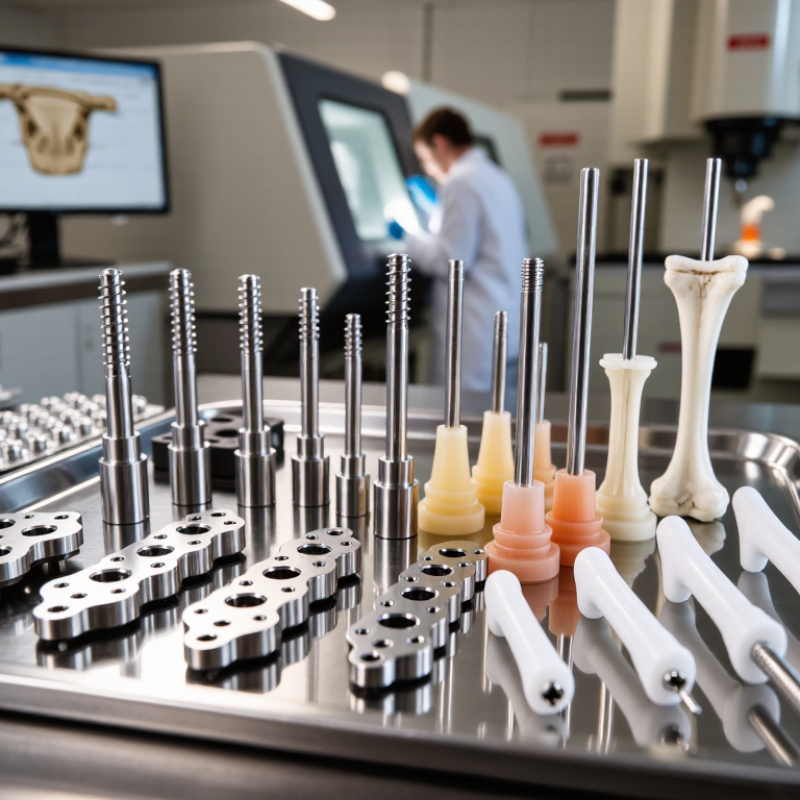
China Top Orthopedic Trauma Implants Manufacturers

China’s Orthopedic Trauma Implants: Types, Materials, and Clinical Uses

China’s orthopedic trauma implant manufacturers produce plates, screws, intramedullary nails, external fixation systems, and joint reconstruction components. These devices support fracture stabilization in the arm, leg, pelvis, and spine. Locking plates help manage fragile bone and complex fractures. Intramedullary nails can control long-bone alignment while reducing soft-tissue disruption. External fixators remain useful when swelling, contamination, or severe injury limits internal fixation.

Common materials include titanium alloys, stainless steel, cobalt-chromium alloys, and selected polymer components. Titanium offers a favorable strength-to-weight ratio and good biocompatibility. Stainless steel remains valued for strength and cost control. Material selection depends on anatomy, loading conditions, imaging needs, and the surgeon’s technique. Clinical outcomes also depend on reduction quality and rehabilitation. The implant alone cannot solve poor positioning.

Tips: Check traceability, material certificates, fatigue data, sterilization information, and surgeon feedback before procurement. Confirm compatibility with instruments and imaging workflows. No implant choice is perfect. A device that performs well in one fracture pattern may be unsuitable in another. I would also question impressive laboratory claims without transparent clinical evidence, testing methods, and post-market monitoring. Manufacturers should provide consistent quality documentation and clear instructions for use. Surgeons need practical training, not only catalog specifications.

China’s Orthopedic Trauma Implants: Types, Materials, and Clinical Uses

Orthopedic trauma implants commonly include plates, screws, intramedullary nails, external fixation components, and wires. Titanium alloys are valued for their high strength-to-weight ratio and corrosion resistance, while stainless steel is widely used for cost-effective plates, screws, and nails. Cobalt-chromium alloys provide high hardness for selected applications, and PEEK is used where radiolucency and imaging visibility are important. The chart compares representative material densities, not manufacturer sales or market share.

Typical Implant Types and Clinical Uses

  • Bone plates and screws: Used for fracture compression, neutralization, buttress fixation, and locking fixation in long bones, periarticular regions, and the hand and foot.
  • Intramedullary nails: Inserted into the medullary canal to stabilize fractures of the femur, tibia, and humerus while sharing load along the bone axis.
  • External fixation systems: Used for severe soft-tissue injury, open fractures, temporary damage-control stabilization, and limb-length or alignment management.
  • Kirschner wires and cerclage wires: Commonly used for small-fragment fixation, temporary reduction, tension-band constructs, and supplemental stabilization.
  • Material selection: Titanium alloys are lightweight and corrosion-resistant; stainless steel offers established strength and value; cobalt-chromium is harder and stiffer; PEEK is radiolucent and useful in selected imaging-sensitive applications.

China Market Data: 2023 Demand, 2024 Growth, and 2030 Forecasts

China Top Orthopedic Trauma Implants Manufacturers

China’s orthopedic trauma implant market showed firm demand in 2023. Hospitals purchased plates, screws, intramedullary nails, and fixation systems for fractures. An aging population increased hip and wrist fracture procedures. Road injuries and workplace accidents also supported demand. Available market estimates suggest steady expansion, although reporting methods differ between sources. Procurement reforms placed strong pressure on implant prices and supplier margins.

In 2024, market growth is expected to remain near 6% to 9%. Lower-tier hospitals are upgrading surgical capabilities. This is widening access to trauma treatment beyond major cities. Manufacturers are investing in titanium alloys, surface finishing, and instrument compatibility. Clinical teams increasingly examine mechanical testing, sterilization validation, traceability, and surgeon feedback. Small design details matter.

A realistic 2030 outlook points to continued growth, potentially reaching a 6% to 8% annual rate. Forecasts vary because injury statistics, tender policies, and hospital budgets can change quickly. Some projections may overstate rural demand. That deserves scrutiny. Buyers should compare implant performance, revision rates, delivery reliability, and documented clinical evidence. Production capacity alone does not prove medical value. Experienced hospitals often review five years of quality records before approving new suppliers.

Leading Manufacturers Ranked by Revenue, NMPA Approvals, and Product Range

China’s leading orthopedic trauma implant manufacturers should be assessed through three measurable lenses: revenue, NMPA approvals, and product range. Public annual filings and Frost & Sullivan market research indicate that revenue leadership usually reflects hospital access, production scale, and long-term surgeon relationships. It does not automatically prove superior clinical performance. That distinction matters.

NMPA approval volume offers a clearer regulatory signal. The NMPA public registration database shows extensive Class III device activity across plates, screws, intramedullary nails, external fixation systems, and trauma instruments. However, approval counts can mislead. One manufacturer may register many size variations, while another offers fewer, broader systems. Review the registration status, approval dates, intended use, and manufacturing site. Details matter.

Product breadth also separates established suppliers from narrow specialists. Strong portfolios commonly cover upper-limb, lower-limb, pelvic, spinal trauma, and minimally invasive fixation needs. According to China’s National Healthcare Security Administration, the 2021 artificial joint volume-based procurement program achieved an average price reduction of about 82%. This pressure makes cost control increasingly important for trauma suppliers. Revenue rankings should therefore include recurring hospital contracts, not only reported sales. A perfect ranking is unlikely. Data quality varies. Some disclosures remain incomplete, and I would treat any list without registration-level verification cautiously.

China Top Orthopedic Trauma Implants Manufacturers - Leading Manufacturers Ranked by Revenue, NMPA Approvals, and Product Range
Screening Rank Anonymous Manufacturer Profile Revenue Disclosure NMPA Registration Evidence Orthopedic Trauma Product Range Typical Product Categories Public Data Status
1 Manufacturer Profile A Not publicly disclosed as a standalone trauma-implant figure Current NMPA database verification required Broad portfolio covering fixation systems and associated surgical instruments
  • Trauma plates
  • Bone screws
  • Intramedullary nails
  • External fixation systems
Company identity intentionally withheld
2 Manufacturer Profile B Not publicly disclosed as a standalone trauma-implant figure Current NMPA database verification required Large domestic orthopedic portfolio with trauma and reconstructive-device coverage
  • Locking plates
  • Compression screws
  • Intramedullary nails
  • Instrument sets
Company identity intentionally withheld
3 Manufacturer Profile C Not publicly disclosed as a standalone trauma-implant figure Current NMPA database verification required Focused trauma-fixation range with multiple anatomical plate configurations
  • Upper-limb plates
  • Lower-limb plates
  • Pelvic and acetabular fixation
  • Small-fragment screws
Company identity intentionally withheld
4 Manufacturer Profile D Not publicly disclosed as a standalone trauma-implant figure Current NMPA database verification required Mid-to-broad product range emphasizing plates, screws, and minimally invasive fixation
  • Distal radius plates
  • Proximal humerus plates
  • Clavicle plates
  • Cannulated screws
Company identity intentionally withheld
5 Manufacturer Profile E Not publicly disclosed as a standalone trauma-implant figure Current NMPA database verification required Specialized trauma portfolio serving common fracture-fixation procedures
  • Clavicle and shoulder plates
  • Hand and foot plates
  • Small-fragment screws
  • Kirschner wires
Company identity intentionally withheld
6 Manufacturer Profile F Not publicly disclosed as a standalone trauma-implant figure Current NMPA database verification required Selective product range focused on fracture fixation and supporting instruments
  • Standard plates
  • Non-locking screws
  • External fixator components
  • Orthopedic instrument kits
Company identity intentionally withheld
Data qualification: Chinese orthopedic-trauma manufacturers generally do not publish audited revenue figures specifically for trauma implants. NMPA registration counts also change as registrations are renewed, transferred, or withdrawn. Therefore, anonymous manufacturer-level revenue values and approval counts are not presented as verified facts. The screening order is a non-audited comparison framework based on publicly observable portfolio breadth and market visibility.
Recommended verification sources include the official NMPA medical-device database, manufacturer regulatory filings, audited annual reports where available, and current product-registration certificates.

Regulatory Benchmarks: Class III Devices, ISO 13485, and Clinical Evidence

For China’s top orthopedic trauma implant manufacturers, regulatory maturity begins with Class III device discipline. These implants enter high-risk clinical decisions, where sterility, fixation strength, and material performance require documented control. A credible manufacturer maps each design input to testing, risk analysis, and production records. Small gaps matter. A missing traceability link can weaken an otherwise impressive submission.

ISO 13485 should function beyond a certificate on a factory wall. Auditors and hospital buyers should see controlled suppliers, validated processes, complaint handling, and corrective action records. Manufacturing teams need practical experience with machining tolerances, surface treatment, packaging, and sterilization interfaces. Training records must match actual work. That sounds obvious, yet documentation sometimes moves faster than shop-floor understanding. A useful quality system exposes this weakness instead of hiding it.

Clinical evidence gives regulatory claims their necessary weight. Manufacturers should define patient populations, surgical indications, endpoints, follow-up periods, and adverse-event reporting before collecting data. Evidence may include clinical investigations, literature reviews, registry findings, and carefully justified equivalence assessments. Numbers alone are not enough. A study with short follow-up may miss loosening, migration, or revision trends. Independent review, transparent methods, and consistent post-market surveillance help hospitals judge whether performance is repeatable in everyday trauma care. Manufacturers seeking long-term trust must accept uncomfortable findings and improve accordingly.

Product Comparison: Plates, Screws, Intramedullary Nails, and Fixators

China Top Orthopedic Trauma Implants Manufacturers

Product selection should follow fracture biology, not catalog size. The Global Burden of Disease 2019 study estimated 178 million new fractures worldwide, creating sustained demand for reliable fixation systems.

Plates provide controlled compression and strong support near joints. Locking plates can help osteoporotic bone, but their stiffness may become excessive. Screws are small components. Their thread design, core diameter, and insertion torque can determine fixation quality.

Intramedullary nails usually share load along long bones, making them practical for many femoral and tibial fractures. Their performance depends on diameter, curvature, locking options, and accurate targeting. A 2024 market analysis from Grand View Research projected continued growth in orthopedic trauma devices through 2030, reflecting rising trauma care and aging populations. Market growth alone does not prove clinical value. That distinction matters.

External fixators remain useful when swelling, contamination, or soft-tissue injury makes internal fixation unsuitable. They can stabilize quickly, although pin-site care demands disciplined follow-up.

AO Foundation surgical guidance emphasizes alignment, stability, blood supply, and soft-tissue preservation across fixation choices. A dependable manufacturer should provide validated materials, fatigue testing, traceable production, and clear surgical instrumentation. Small details matter. In practice, no implant category wins every case. I would still question comparisons based only on price, market share, or polished mechanical charts. A plate that performs well in a laboratory may frustrate surgeons during a difficult, swollen fracture.

FAQS

What types of orthopedic trauma implants are commonly available?

Common options include plates, screws, intramedullary nails, external fixators, and joint reconstruction components. Each serves different fracture patterns.

When are plates useful?

Plates provide controlled compression and support near joints. Locking plates may help fragile bone, but excessive stiffness can affect healing.

What role do screws play?

Screws secure plates or fragments. Thread design, core diameter, and insertion torque can strongly influence fixation quality.

When might an intramedullary nail be selected?

Nails often support long-bone fractures in the femur or tibia. Their performance depends on diameter, curvature, locking options, and targeting accuracy.

When are external fixators considered?

External fixators can stabilize injuries when swelling, contamination, or soft-tissue damage limits internal fixation. Pin-site care requires regular follow-up.

Which materials are used in these implants?

Common materials include titanium alloys, stainless steel, cobalt-chromium alloys, and selected polymers. Titanium balances strength, weight, and biocompatibility.

How should buyers evaluate an implant system?

Check traceability, material certificates, fatigue data, sterilization records, and surgeon feedback. Confirm instrument compatibility and imaging requirements.

Does the implant alone determine clinical results?

No. Reduction quality, positioning, blood supply, soft-tissue handling, and rehabilitation also matter. A strong implant cannot correct poor placement.

Should laboratory performance decide product selection?

Not by itself. Ask for testing methods, clinical evidence, and post-market monitoring. Impressive charts may not reflect difficult surgery.

Is one implant category best for every fracture?

No. Product selection should follow fracture biology, anatomy, loading conditions, and surgical technique. One choice may work poorly elsewhere.

Conclusion

China’s Orthopedic Trauma Implants sector offers a broad range of solutions for fracture fixation, including plates, screws, intramedullary nails, and external fixators. These products are commonly manufactured from medical-grade titanium alloys, stainless steel, and other biocompatible materials, with designs adapted to different anatomical sites and clinical needs. Market demand is supported by aging populations, rising trauma treatment requirements, hospital modernization, and expanding orthopedic care. Current industry analysis focuses on 2023 demand, expected growth in 2024, and long-term development toward 2030.

Leading manufacturers can be evaluated through revenue performance, product diversity, NMPA approvals, manufacturing capacity, and after-sales support. Regulatory benchmarks typically include Class III device compliance, ISO 13485 quality management systems, risk control, and appropriate clinical evidence. When comparing products, hospitals and distributors should consider fixation strength, anatomical fit, surgical efficiency, material properties, imaging compatibility, and lifecycle value. Together, these factors provide a practical framework for assessing China’s orthopedic trauma implant market and its future opportunities.


Lillian

Lillian

Lillian is a dedicated marketing professional with extensive knowledge of the company’s products, services, and industry applications. Through a thoughtful combination of market insight, customer understanding, and clear communication, she helps connect practical solutions with the people and......
