Discover expert surgical guides, manufacturing standards, and clinical innovations across spinal, trauma, and arthroscopy implant technologies.

Stay informed with in-depth technical analysis on titanium alloys, pedicle screws, PEEK cages, and modern orthopedic instrumentation.
Explore our clinical-grade, CE & ISO 13485 certified orthopedic bone retractor systems engineered for spinal surgeries, joint reconstruction, trauma management, and veterinary orthopedics. Manufactured from biocompatible German & Japanese stainless steel (SS316L/SS LVM) and Titanium Grade 5 alloys.
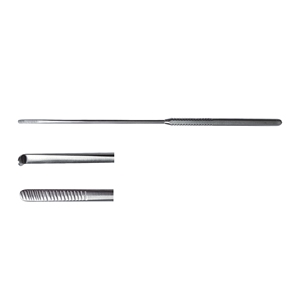
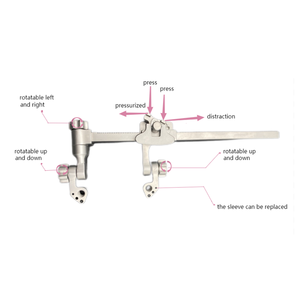
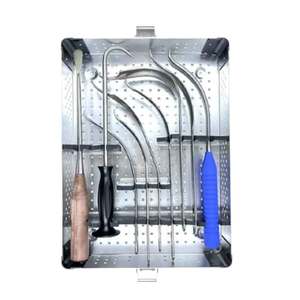
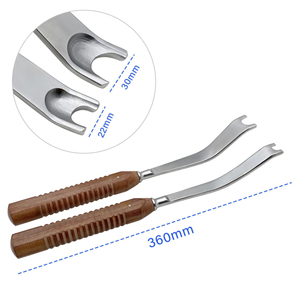
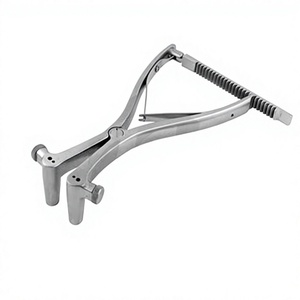
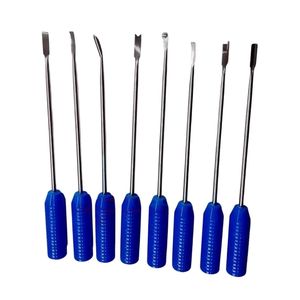
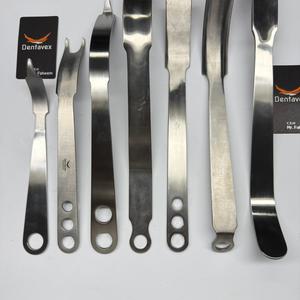
In modern musculoskeletal surgery, surgical exposure is the single most critical determinant of procedural safety, anatomical visualization, and operative speed. Orthopedic bone retractor sets are not merely passive holding instruments; they are structural levers subjected to continuous mechanical torque, lateral tension, and cyclic fatigue while remaining in direct contact with cortical bone, soft tissue, nerve roots, and microvascular bundles.
Leading Chinese medical device exporters and OEM/ODM manufacturers have transformed retractor manufacturing by shifting from standard industrial steel alloys to specialized medical-grade metallurgical compositions. The benchmark material for premium retractor sets—such as Hohmann, Hintermann, and UBE spinal retractors—is AISI 316L Stainless Steel (ASTM F138 / ISO 5832-1) or Vacuum Melted Stainless Steel (SS LVM). Furthermore, for radiolucent and lightweight intraoperative applications, high-tensile Titanium Grade 5 (Ti-6Al-4V ELI / ASTM F136) is increasingly utilized.
Instruments undergo nitric or citric acid chemical passivation (ASTM A967) to form a chromium-oxide protective layer, resisting pitting corrosion caused by saline flush and autoclave steam sterilization cycles (134°C at 2.1 bar).
Surgical operating lights generate high intensity (up to 160,000 Lux). Retractor blades are finished with micro-bead satin blasting or Physical Vapor Deposition (PVD) titanium nitride/carbon coatings to eliminate visual glare and reduce surgeon eye strain.
Curvature angles, blade widths (ranging from 8mm narrow tips to 70mm broad levers), and anatomical finger grooves are precision-milled via 5-axis CNC machines to ensure optimal force distribution without atraumatic tissue necrosis.
Evaluating the architectural differences, clinical applications, and procurement specifications of top Chinese exporter offerings.
| Retractor System Type | Primary Clinical Application | Key Mechanical Design Features | Core Material Grade | Sterilization Compatibility |
|---|---|---|---|---|
| Hohmann Bone Retractor Set | Hip, Knee & Long Bone Fracture Surgeries | Narrow/Broad curved beak, leverage finger ring, contoured handle for bone levering | AISI 316L / SS LVM Medical Steel | Autoclave (134°C), ETO, Gamma Sterilization |
| Hintermann Retractor Set | Ankle, Foot & Small Joint Open Reductions | Dual-pin spreading mechanism, low-profile distraction arms, locking ratchet bar | German Stainless Steel 1.4121 / SS316L | Autoclave, Dry Heat, Chemclave |
| UBE Spine Retractor Set | Unilateral Biportal Endoscopy & Spine Minimally Invasive Surgery | Irrigation port access, ultra-thin working channel blades, bone wax applier integration | Titanium Grade 5 / Non-Magnetic SS | Autoclave (134°C), Low-Temp Plasma |
| Hip Joint Cement Retractor Set | Total Hip Arthroplasty (THA) & Revision Surgery | Polished cement-scraper tips, heavy-duty lever shafts, double-angled offset blades | High-Tensile Stainless Steel (17-4PH) | Autoclave (134°C), ETO |
| Veterinary Orthopedic Set | Small Animal & Equine Bone Fracture Repair | Compact bone compressor/distractor, adjustable joint spreader, multi-size blades | Biocompatible SS304 / SS316L | Autoclave, Boiling, Chemical Soak |
The global orthopedic surgical instrument market is undergoing a seismic structural shift. Hospital procurement departments, tier-1 medical brands, and regional distributors are re-evaluating traditional European supply chains in favor of high-tier Chinese manufacturers who offer equivalent metallurgical rigor, strict regulatory compliance, and significant cost advantages.
Key procurement and technological trends defining the next decade of orthopedic retractor sourcing include:
When evaluating a Chinese OEM supplier for orthopedic retractor sets, always audit their 5-axis CNC machining center capabilities, CMM (Coordinate Measuring Machine) laser inspection protocols, and passivation testing reports (Salt Spray Test ASTM B117). Choosing a manufacturer with in-house tooling capabilities guarantees batch-to-batch consistency and speeds up custom prototype development from months to under 14 days.
As an established global OEM/ODM manufacturing force, our integrated production facilities bridge state-of-the-art engineering precision with cost-effective industrial scaling. We operate in full compliance with ISO 13485:2016, US FDA GMP, and CE certification protocols, serving healthcare partners across 30+ nations.
Equipped with multi-axis VMC/CNC machining centers, automatic sliding-head Swiss lathes, and wire EDM systems capable of achieving micro-tolerances down to ±0.005mm on complex retractor hinge joints and locking teeth.
Every single batch of raw SS316L, SS LVM, and Titanium Grade 5 undergoes spectrographic chemical analysis and hardness testing (HRC). 100% visual, dimensional, and functional torque testing is performed before sterilization packaging.
We support global distributors, hospital supply chains, and brand owners with fast delivery timelines, customs clearance documentation, custom-branded sterilization boxes, laser markings, and flexible MOQs.
Essential questions and technical answers for hospital purchasing committees, medical distributors, and OEM partners.
To assist global procurement officers and medical buyers in evaluating China-based orthopedic instrument exporters, we recommend verifying the following 6-point technical checklist before releasing Purchase Orders (POs):
Ensure the supplier provides mill test certificates proving carbon content is <0.03% for SS316L to guarantee intergranular corrosion resistance after autoclaving.
Confirm compliance with ASTM A967 or ISO 16061 boiling water / salt spray tests to prevent premature rusting in high-humidity operating environments.
Retractor shafts must withstand high bending moments (up to 120 Nm depending on blade size) without permanent plastic deformation or micro-fracturing.
Blade surface roughness should be controlled to Ra < 0.4 µm (polished) or satin blasted to prevent microbial retention and ensure effortless ultrasonic cleaning.
Handles must be anatomically counterweighted to reduce surgeon hand fatigue during prolonged procedures lasting several hours.
Laser marking must support high-density GS1 DataMatrix or QR coding for seamless hospital EHR integration and device tracking.
Looking for reliable supply chain solutions, competitive factory-direct pricing, or custom OEM manufacturing for your orthopedic retractor line? Contact our technical engineering team today for instant quotes and product samples.