
Discover expert surgical guides, manufacturing standards, and clinical innovations across spinal, trauma, and arthroscopy implant technologies.

Stay informed with in-depth technical analysis on titanium alloys, pedicle screws, PEEK cages, and modern orthopedic instrumentation.
Explore top-tier orthopedic surgical products engineered for all-inside, inside-out, and soft-anchor arthroscopic meniscal repairs. Manufactured under ISO 13485 and CE protocols.
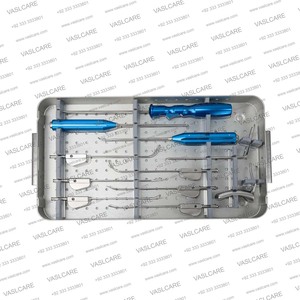
Precision manual arthroscopy set featuring corrosion-resistant 1.4116 German stainless steel, ergonomic handles, and a 3-year structural performance warranty.
Contact Us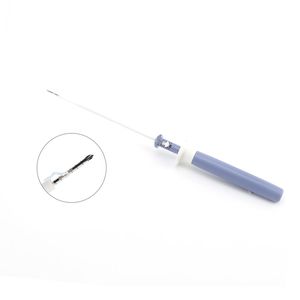
Pre-loaded active delivery system with dual PEEK implants and high-strength braided UHMWPE suture. Designed for low-profile posterior horn tear repairs.
Contact Us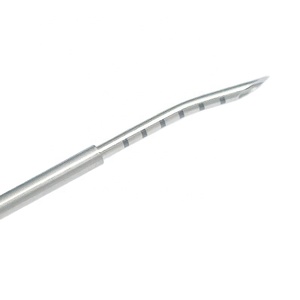
Ultra-sharp curved needle delivery shaft providing mechanical stability and consistent deployment depth during high-tension arthroscopic suturing.
Contact Us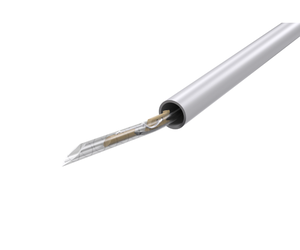
Tactile cigar-style actuation handle enabling single-handed depth setting and active T-block toggle deployment with controlled suture tensioning.
Contact Us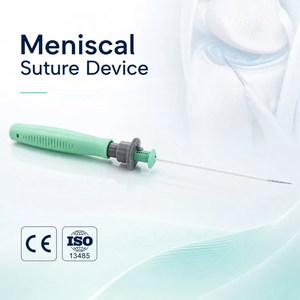
Advanced curved suture gun kit optimized for anatomic contouring around the medial and lateral meniscus without scuffing femoral cartilage.
Contact Us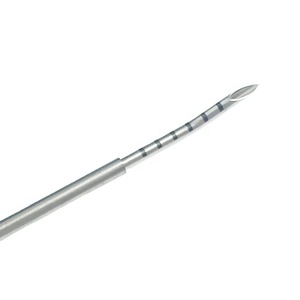
Swiss CNC-machined stainless steel inside-out cannula needles featuring laser-etched depth calibrations and micro-polished internal lumens.
Contact Us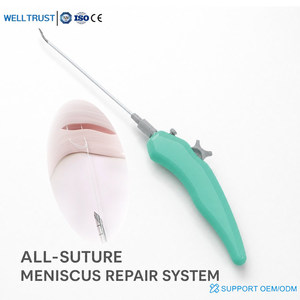
All-suture anchor technology utilizing 12-degree and 24-degree pre-bent inserters for non-rigid anatomical fixation and minimal tissue disruption.
Contact Us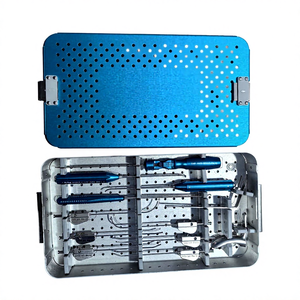
Comprehensive revision suite incorporating specialized suture cutters, knot pushers, rasp blades, and extraction probes for complex knee reconstructions.
Contact UsThe global sports medicine industry is undergoing a paradigm shift from partial meniscectomy (tissue resection) to meniscus preservation and anatomical repair. The human meniscus plays a critical biomechanical role in load distribution, joint stability, shock absorption, and articular cartilage protection. Clinical literature demonstrates that preserving meniscal volume significantly delays the onset of post-traumatic osteoarthritis in the knee joint.
Consequently, global demand for advanced meniscal repair systems—specifically all-inside suture devices, inside-out cannulated needle sets, and all-suture soft anchors—has accelerated at a Compound Annual Growth Rate (CAGR) exceeding 7.2%. Leading hospital networks, orthopedic ambulatory surgery centers (ASCs), and medical device distributors are increasingly turning to top China meniscal repair system factories and suppliers to secure high-performance, cost-effective, and fully certified implants.
Selecting the optimal repair system requires a detailed understanding of the tear geometry (bucket-handle, radial, horizontal cleavage, complex, or root tears) and the vascular zone (red-red peripheral zone vs. red-white transition zone). Leading manufacturers supply three core surgical platforms:
Pre-loaded delivery guns featuring active toggling PEEK T-locks or bioresorbable implants joined by pre-tied UHMWPE slipknots. Eliminates additional counter-incisions.
Long flexible Nitinol or stainless steel cannulated needles used with pop-through zone guards. Ideal for anterior and middle-third body tears demanding high suture density.
Rigid-implant-free fixation systems that expand beneath the posterior capsule. Minimizes joint cartilage erosion while delivering superior initial pull-out strength.
When evaluating China sports medicine instrument factories, medical procurement officers must scrutinize raw material sourcing, mechanical yield strength, pull-out force thresholds, and delivery system shaft geometry. The following benchmark table outlines standard engineering specifications provided by premier manufacturing facilities.
| System Architecture | Implant / Anchor Material | Suture Construction | Shaft Outer Diameter | Mean Pull-Out Force | Primary Clinical Target |
|---|---|---|---|---|---|
| All-Inside T-Lock | PEEK OPTIMA / PLLA Bioresorbable | #2-0 UHMWPE Braided Suture | 1.55 mm - 1.65 mm | > 110 N | Posterior Horn & Mid-Body Tears |
| Active Suture Gun | Non-Rigid Soft Suture Anchor | High-Molecular Polyethylene | 1.40 mm Micro-Needle | > 95 N | Red-Red & Red-White Zone Suturing |
| Inside-Out System | German Stainless Steel (1.4116) | #0 / #2-0 Braided Polyester | 1.20 mm Flexible Shaft | Depends on Knot Technique | Complex & Multi-Planar Tear Patterns |
| All-Suture 12°/24° | Sub-cortical Fabric Sleeve | Co-braided UHMWPE + Monofilament | 1.35 mm Micro-Shaft | > 125 N | Root Tear & Revision Arthroscopy |
Precision execution during Swiss CNC turning ensures that internal lumen tolerances are maintained within ±0.005mm. This prevents suture binding or fraying during high-tension single-handed deployment, a common issue in lower-tier generic instruments.
The sports medicine procurement landscape is shifting rapidly. Hospital purchasing groups and international OEMs must align their 3-to-5-year sourcing strategies with the following technological trajectories:
Surgeons are demanding smaller outer-diameter delivery needles. Legacy 2.0mm shafts present a risk of iatrogenic cartilage scuffing during tight medial compartment access. Next-generation Chinese factories are utilizing ultra-stiff, custom-tempered alloy needles with outer diameters of 1.35mm to 1.45mm, providing structural stiffness without flexing while drastically reducing joint entry trauma.
Rigid plastic or metallic implants carry risks of migration, chondral abrasion, or osteolysis over long-term patient follow-up. Future procurement trends heavily favor all-suture anchors and bio-inductive collagen scaffolds that stimulate endogenous tissue healing before resorbing completely into native fibrocartilage.
Operating room efficiency is directly linked to procedure time. Modern all-inside systems pre-integrate low-profile, self-locking slipknots (such as modified Weston or Cobbler knots) that automatically tension during deployment, reducing surgeon knot-tying steps and shortening operative duration by up to 25%.
With the implementation of the European Union Medical Device Regulation (EU MDR 2017/745) and stringent US FDA audits, hospital networks can no longer rely on unverified third-party trading entities. Global buyers now establish direct partnerships with fully audited China factories that provide complete Material Test Reports (MTRs), ISO 13485 cleanroom validation, and technical documentation packages for rapid regulatory clearing.
As a premier OEM/ODM manufacturer specializing in orthopedic trauma, spinal fixation, and sports medicine arthroscopy systems, our state-of-the-art facility integrates advanced European metallurgic standards with high-precision Asian manufacturing efficiency.
From raw material selection—including medical-grade Titanium Grade 5 (Ti-6Al-4V ELI), PEEK OPTIMA, and German Stainless Steel (SS316L / 1.4116)—to automated optical CMM inspection and EtO pouch sealing, every step is rigorously monitored to guarantee zero-defect clinical reliability.
Initiate OEM / ODM Supplier InquiryEssential guidance for orthopedic product managers, hospital procurement teams, and medical device importers sourcing meniscal repair hardware from China factories.
International buyers must verify that the manufacturing facility holds an authentic ISO 13485:2016 certification for medical device quality management. For sales within the European Union, products must carry CE marking under EU MDR 2017/745. For the US market, 510(k) clearance or contract manufacturing registration with FDA 21 CFR Part 820 compliance is required. Top suppliers provide complete technical documentation including bio-compatibility reports (ISO 10993) and sterilization validation (ISO 11135 for EtO).
All-Inside PEEK implants utilize small, solid Polyetheretherketone T-blocks that toggle behind the joint capsule to anchor the suture. They offer high initial mechanical rigidity. All-suture anchors utilize flexible fabric sleeves that bunch up sub-cortically upon tensioning. All-suture systems eliminate rigid hardware, drastically reducing the risk of articular cartilage damage if implant displacement occurs, making them increasingly popular for younger, active patients.
Yes, leading China factories specialize in comprehensive OEM/ODM services. This includes custom laser engraving of distributor logos, custom-curved needle shaft geometries (e.g., 12°, 24°, or reverse curve configurations), customized handle color coding, and sterile blister tray packaging with private-label IFUs (Instructions for Use) in multi-language formats.
Ultra-High-Molecular-Weight Polyethylene (UHMWPE) braided sutures undergo automated tension testing during assembly. Factories test breaking strength, creep resistance, and knot security according to ASTM F2267 standards. Each production batch undergoes 100% optical inspection to confirm zero fraying and precise pre-tied slipknot geometry before entering Class 100,000 cleanrooms for pouching.
For standard catalog products under factory branding, MOQs typically start at 50 to 100 units. For custom OEM white-label production (requiring custom injection molds or specialized needle bends), MOQs generally range from 500 to 1,000 units. Lead times for standard orders are 2 to 3 weeks, while custom OEM runs require 4 to 6 weeks including EtO sterilization validation.
Reusable manual instruments (rasp blades, suture retrievers, knot pushers, and inside-out cannula handles) are manufactured from high-grade German stainless steel (such as 1.4116 or SS316L). They are fully validated for repeated steam autoclave sterilization cycles at 134°C (273°F). Pre-cleaning with enzymatic detergents and ultrasonic bath processing is recommended to maintain joint articulation and shaft lumen cleanliness.
Whether you are seeking high-volume OEM manufacturing, private-label hospital supply contracts, or specialized sports medicine distribution rights, our engineering team provides complete support from prototype design to regulatory clearance.
