
Discover expert surgical guides, manufacturing standards, and clinical innovations across spinal, trauma, and arthroscopy implant technologies.

Stay informed with in-depth technical analysis on titanium alloys, pedicle screws, PEEK cages, and modern orthopedic instrumentation.
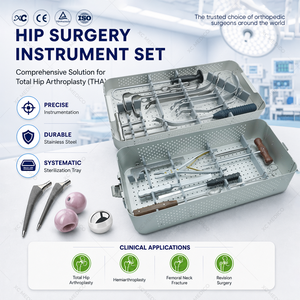
Engineered for primary and revision total hip arthroplasty (THA). Features high-grade stainless steel reamers, acetabular cup impactors, and femoral stem rasps with ergonomic silicone handles.
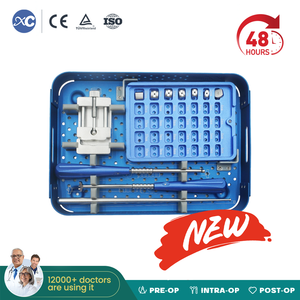
Precision anterior cervical discectomy and fusion (ACDF) kit. Includes trial cages, distraction pins, graft stoppers, and quick-connect inserters for radiolucent PEEK cages.
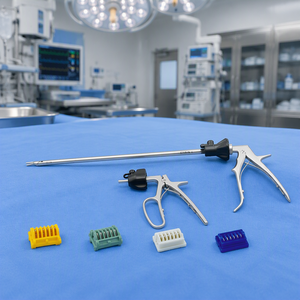
360-degree articulating surgical instruments crafted for delicate tissue manipulation during endoscopic and anterior retroperitoneal spine exposures. Features tactile force feedback handles.
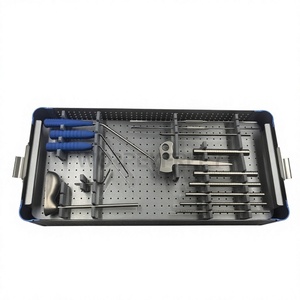
Specialized Unilateral Biportal Endoscopic (UBE) spinal decompression set. Designed for targeted ligamentum flavum resection, lumbar discectomy, and neural canal enlargement.
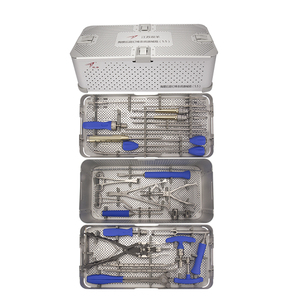
Heavy-duty posterior thoracolumbar pedicle screw system instrument tray. Complete with polyaxial screw drivers, French rod benders, torque-limiting wrenches, and counter-torque sleeves.
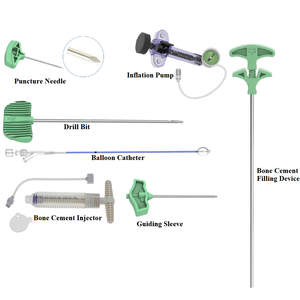
Percutaneous vertebral compression fracture (VCF) repair kit. Contains radiopaque balloon catheters, osteotome drill cannulas, hydraulic inflation devices, and bone cement pushers.
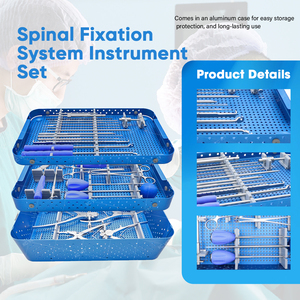
Rugged veterinary orthopedic spinal instrument kit for small and large animal neurosurgery. Features micro-pedicle screw inserters, spinal hemilaminectomy drills, and plate benders.
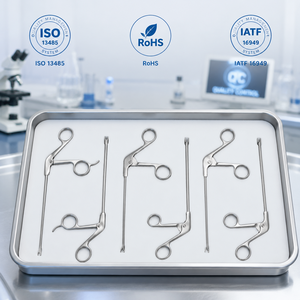
Essential micro-decompression kit comprising 45° forward punch Kerrison rongeurs, pituitary disc forceps, and bone biting rongeurs. German-milled cutting jaws prevent bone slipping.
Spinal surgery has undergone a radical paradigm shift over the past decade. The industry transition from open posterior fusion to Minimally Invasive Spine Surgery (MISS), Unilateral Biportal Endoscopy (UBE), and navigation-guided robotics has imposed unprecedented requirements on surgical instrument manufacturers. Spine surgery instrument sets are no longer passive mechanical hand tools; they are high-precision mechanical interfaces engineered to transmit precise tactile feedback while enduring extreme cyclical mechanical stresses and repeated steam sterilization cycles.
When evaluating top trusted spine surgery instrument set factories and suppliers, procurement officers, OEM partners, and hospital surgical boards must analyze manufacturing capabilities beyond basic physical assembly. A premium instrument set must satisfy three fundamental clinical vectors: Biomechanical Integrity, Ergonomic Force Transmission, and Absolute Metallurgical Inertness.
The clinical failure of a surgical instrument—such as jaw galling in a Kerrison rongeur, shaft distortion in a pedicle screwdriver, or surface pitting following autoclave cycles—is directly attributable to inferior raw material selection or compromised post-machining passivation. Elite global manufacturers utilize strict medical-grade alloys compliant with international standards:
| Material Standard | Composition / Grade | Mechanical Properties | Primary Clinical Application |
|---|---|---|---|
| ASTM F136 / ISO 5832-3 | Ti-6Al-4V ELI (Extra Low Interstitial) | Tensile Strength > 860 MPa, Lightweight, Non-Magnetic | Spinal Rod Benders, Trial Cages, Implantation Drivers |
| ASTM F899 / DIN 1.4121 | Martensitic Stainless Steel (AISI 420 C/D) | Hardness 50-56 HRC, Extreme Edge Retention | Kerrison Rongeur Jaws, Bone Chisels, Osteotomes |
| ASTM F899 / DIN 1.4301 | Austenitic Stainless Steel (AISI 316L) | Superior Corrosion Resistance, High Ductility | Retractor Frames, Sterilization Trays, Outer Handles |
| ASTM F2026 | PEEK (Polyether Ether Ketone) & Radel PPSU | Radiolucent, Autoclavable up to 134°C, High Impact Strength | Trial Interbody Cages, Insulated Endoscopic Sheaths |
To ensure absolute resistance to intergranular corrosion and stress corrosion cracking (SCC), top-tier suppliers execute double-stage citric or nitric acid passivation in strict accordance with ASTM F86 protocols. This creates a uniform, self-healing chromium oxide ($\text{Cr}_2\text{O}_3$) passive layer on all stainless surfaces, preventing metal ion leaching during exposure to biological fluids and enzymatic cleaners.
In posterior thoracolumbar pedicle screw systems, set-screw tightening represents a critical phase of spinal stabilization. Undertightening leads to construct slippage and pseudoarthrosis, whereas overtightening risks thread stripping or pedicle wall fracture. Factory-calibrated torque-limiting wrenches (typically calibrated between 5.0 Nm and 12.0 Nm depending on the screw system diameter) are essential components of modern surgical sets. Leading factories utilize internal slip-clutch mechanisms sealed within hermetic housings to maintain calibration accuracy within ±6% across over 1,000 autoclave cycles.
Production lines equipped with DMG MORI and Citizen Swiss automatic lathes achieving micro-tolerances down to ±0.005mm for delicate threads, quick-connect couplings, and cannulated shafts.
100% CMM dimensional audit, optical comparator verification, surface roughness measurement (Ra < 0.4µm), and rigorous mechanical endurance testing prior to sterile packaging.
Fully customizable PPSU and anodized aluminum sterilization trays with custom silicone positioning brackets, laser-engraved asset labeling, and optimized steam circulation ports.
As global healthcare systems focus on reducing operating room turnaround times and surgical complication rates, B2B procurement strategies for spine surgery instrument sets are rapidly evolving. Leading hospital networks, orthopedic distributors, and brand owners must align with the following technological trends:
With the adoption of intraoperative CT and optical navigation systems (such as Medtronic StealthStation or Brainlab), manual spine instruments must now integrate rigid navigation tracking arrays. Instrument factories must manufacture calibrated spherical reflector posts and optical pin connectors directly into pedicle screwdrivers, taps, and awls to ensure sub-millimeter positional tracking accuracy.
Traditional fixed-footplate Kerrison rongeurs present severe cleaning challenges in sterile processing departments (SPD). Dried blood and bone debris accumulating inside the slider channel can cause cross-contamination or mechanical binding. Next-generation instrument sets feature Take-Apart / Hinged Clean-Out mechanisms allowing SPD technicians to open the slide rail without tools for 100% direct visual inspection and ultrasonic cleaning.
To reduce surgeon hand fatigue during multi-level spinal fusion procedures, traditional stainless steel handles are being replaced by lightweight carbon-fiber and PEEK composites. These materials reduce instrument weight by up to 40% while maintaining absolute structural rigidity and resistance to chemical disinfectants.
Comprehensive technical answers regarding ordering, customization, quality assurance, and regulatory compliance from our engineering team.
Remak Ortho Pvt Ltd stands as a premier Indian FDA-approved, CE certified, and ISO 13485 compliant manufacturer of spinal fixation systems, trauma implants, and precision surgical instruments. Utilizing state-of-the-art multi-axis CNC machine tools, Swiss sliding head turning centers, and fully automated passivating plants, we empower medical device brands, hospital chains, and global importers across 30+ countries with uncompromised quality and competitive factory-direct pricing.
Rapid international logistics network supporting OEM buyers across Europe, Latin America, Middle East, Southeast Asia, and Africa with complete customs documentation and certificate of origin.
One-stop manufacturing for spinal pedicle screws, PEEK cages, cervical plates, trauma intramedullary nails, locking plates, and custom surgical instrument trays.
Direct manufacturer pricing with zero middleman markups, reducing overall procurement costs by up to 35% without sacrificing material quality or surgical precision.
Connect directly with our senior orthopedic engineering team. Receive technical CAD consultations, custom tray quotations, and sample validation within 24 hours.
